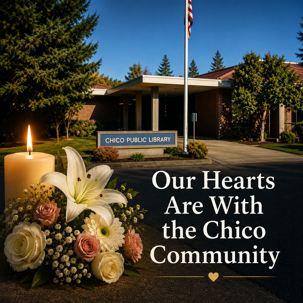
Our hearts are with the families of Robert Johnson and Jacob Hull, the two men whose lives were taken in the recent Chico library shooting. We also extend our deepest sympathy to the injured child, the child's family, the witnesses, first responders, library staff, and everyone in our community affected by this devastating act of violence.
No words can undo the grief caused by a senseless public shooting. In moments like this, the first priority must be compassion for the victims and their loved ones. At the same time, our community is entitled to ask difficult questions about how this happened, whether warning signs were missed, and whether preventable failures contributed to the loss of innocent lives.
According to public reporting, prosecutors have stated that the suspect posted a video online shortly before the attack indicating an intent to go to the Chico library and shoot as many people as possible. Authorities have also reported that the investigation remains ongoing. As with any developing matter, final conclusions should be based on evidence, not speculation.
Still, this tragedy raises important general questions for the public about safe firearm storage, civil accountability, and the rights of families after a wrongful death.
California Law Requires Responsible Firearm Storage
California law recognizes that firearms are dangerous instruments that must be handled and stored with extreme care. State law requires firearms in a residence to be securely stored when they are not being carried or readily controlled by the owner or another lawful authorized user. In general terms, secure storage means keeping the firearm in a compliant locked safe or using an approved firearm safety device.
The reason for these laws is straightforward: unsecured firearms can be accessed by people who should not have them, including children, prohibited persons, emotionally unstable individuals, or others who may use the weapon to harm themselves or innocent members of the public.
When a firearm is left unsecured and someone takes it and uses it to injure or kill another person, California law may allow victims and their families to pursue claims not only against the shooter, but also against others whose negligence contributed to the harm. Those claims depend on the facts, including:
- Whether the firearm was legally required to be secured;
- Whether it was actually secured;
- Who had access to the residence or the firearm;
- Whether the owner knew or should have known that someone might access the weapon;
- Whether there were warning signs, threats, violent statements, prior conduct, or online posts;
- Whether the unsecured firearm was a substantial factor in causing the injury or death; and
- Whether insurance coverage may be available for the claim against the gun owner.
Can an Unsecured Gun Lead to Civil Liability?
In many cases, yes. If a gun owner violates a firearm-storage law, that violation may support a claim that the owner was negligent. In legal terms, this is sometimes described as negligence per se, meaning the violation of a safety statute can create a presumption that the defendant failed to use reasonable care.
That does not mean every gun owner is automatically liable whenever someone else commits a crime with a firearm. The family still must prove causation and damages. But where the very purpose of the storage law is to prevent unauthorized access to firearms, a strong argument can be made that a shooting caused by an unsecured firearm is exactly the type of harm the law was designed to prevent.
Defendants in these cases may argue that the shooter's criminal act was a "superseding cause" that cuts off liability. But that argument is not automatic. If the risk that made the gun owner's conduct negligent was the risk that someone would take and misuse the firearm, then the later criminal act may be viewed as part of the foreseeable chain of events not a complete defense.
The facts matter. A case becomes stronger where evidence shows that the shooter had access to the residence, access to the firearm, prior violent statements, online threats, fascination with mass violence, known instability, or other warning signs that should have caused a responsible gun owner to secure the weapon.
Rights of Families After a Wrongful Death
When a loved one is killed because of another person's wrongful conduct, California law may allow surviving family members to bring a wrongful death claim. Depending on the circumstances, statutory heirs may seek compensation for the profound losses caused by the death, including the loss of love, companionship, care, guidance, support, and other legally recognized damages.
In cases involving catastrophic public violence, families may also need answers to urgent questions:
- Who owned the firearm?
- How was the firearm stored?
- Who had access to it?
- Were there warning signs before the shooting?
- Did anyone know about threats or disturbing online activity?
- Were law enforcement, school officials, family members, or others aware of prior concerns?
- Is there homeowner's insurance, renter's insurance, umbrella insurance, or another personal liability policy that may provide coverage?
Insurance coverage is often a critical issue. Claims against an intentional shooter are frequently excluded from coverage. But claims against a separate person — such as a gun owner accused of negligent storage, negligent supervision, or failure to secure a weapon — may present different coverage questions. Depending on the policy language and facts, there may be a duty to defend or potential coverage for negligence-based claims.
These cases require immediate investigation. Evidence can disappear quickly, including social media posts, text messages, videos, security footage, firearm-storage evidence, witness statements, and insurance information.
Local Experience Matters in Catastrophic Injury and Wrongful Death Cases
Our firm has more than 100 years of combined legal experience handling catastrophic injury and wrongful death cases. As prominent local attorneys, we understand the Chico community, the local courts, the importance of prompt investigation, and the devastating impact these tragedies have on families.
Cases involving shootings, unsafe firearm storage, catastrophic injuries, and wrongful death are complex. They may involve criminal proceedings, civil liability, insurance coverage disputes, public records, law enforcement investigations, digital evidence, expert testimony, and sensitive communication with grieving families.
Our role is to help families understand their rights, preserve evidence, identify all potentially responsible parties, and pursue accountability through the civil justice system when the facts support a claim.
We approach these cases with compassion, discretion, and determination. Families dealing with sudden loss should not have to navigate the legal system alone.
A Message to the Community
To the families of Robert Johnson and Jacob Hull, and to everyone harmed by this tragedy: we offer our sincere condolences. We recognize that no lawsuit can replace a life, restore a family, or erase the trauma of violence. But civil accountability can help uncover the truth, promote safety, and provide resources for families facing unimaginable loss.
If your family has been affected by a catastrophic injury or wrongful death, our attorneys are available to discuss your rights and options in a confidential consultation.
Contact our office today to speak with experienced local wrongful death and catastrophic injury attorneys.

This post is provided for general informational purposes only and does not constitute legal advice. Every case depends on its specific facts, evidence, applicable law, and available insurance coverage. If you have questions about a particular matter, you should consult with an attorney about your specific circumstances.