
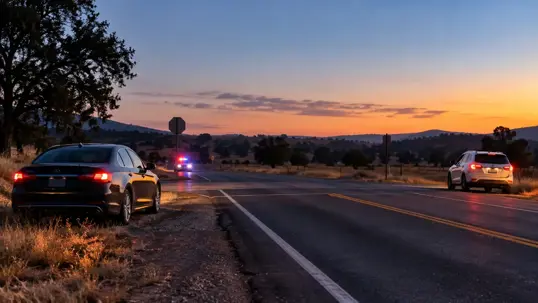
A DUI prosecution does not automatically decide a California personal-injury claim. Prosecutors pursue criminal charges on behalf of the state, while an injured person may bring a civil claim seeking compensation for losses caused by another party. The proceedings can rely on some of the same evidence, but they have different purposes, burdens of proof, parties, and deadlines.
That distinction matters after any suspected impaired-driving collision. A guilty plea or conviction can be important, but an injured person generally should not assume that the criminal court will resolve medical bills, lost income, future care, or insurance disputes. Likewise, a not-guilty plea is not a finding that no one was injured or that civil responsibility has been decided.
What happened in the recent Butte County case?
On September 9, 2026, an Oroville woman pleaded not guilty to felony charges arising from an August collision near Rio Bonito Road and Highway 99. According to KRCR's report of the court proceeding, prosecutors allege that an SUV failed to stop before colliding with a marked Paradise Police Department vehicle. A police sergeant and a six-year-old child reportedly suffered significant injuries.
The defendant is presumed innocent unless and until the charges are proven. The report states that a preliminary hearing was scheduled for September 23, 2026. At that stage, a judge determines whether prosecutors have presented enough evidence for the criminal case to proceed; it is not a civil trial and does not calculate compensation for an injured person.
How are the criminal and civil cases different?
The criminal case focuses on whether the government can prove charged offenses and, if there is a conviction, what sentence is authorized. The prosecutor controls that case. An injured person may be a witness or crime victim, but is not the party bringing the prosecution.
A civil injury claim focuses on whether another person or entity is legally responsible for harm and, if so, what compensation is supported by the evidence. The injured person controls the civil claim with counsel. The claim may begin with insurance investigation and negotiation before any lawsuit is filed.
Criminal charges generally must be proved beyond a reasonable doubt. Most civil factual issues use the lower preponderance-of-the-evidence standard, often explained as whether something is more likely than not. Because the standards differ, the outcome of one proceeding does not always predict the outcome of the other.
What evidence may overlap?
Police reports, witness statements, video, vehicle damage, roadway measurements, body-camera footage, dispatch records, chemical-test records, and medical documentation may matter in both proceedings. That does not mean every record is immediately available to every party or admissible for every purpose.
In the Butte County matter, prosecutors told KRCR that their evidence includes eyewitness accounts, residential surveillance footage, and a blood sample obtained under a search warrant. Those statements describe the prosecution's position. The defense can challenge the evidence, its interpretation, and whether the government can meet its burden.
Criminal investigators, insurers, and civil attorneys may examine overlapping records for different purposes.
Should an injured person wait for the criminal case to end?
Usually, waiting without obtaining case-specific advice is risky. Video can be overwritten, vehicles can be repaired, witnesses can become difficult to locate, and insurance deadlines can arise while a criminal case remains pending. California Code of Civil Procedure section 335.1 generally allows two years for many personal-injury lawsuits, but shorter notice rules and other exceptions can apply. A claim involving a public entity can present additional deadlines and procedural questions.
An attorney can investigate and preserve civil evidence while coordinating carefully with an active criminal proceeding. That work must respect court orders, privacy rights, law-enforcement restrictions, and the defendant's constitutional rights. It may be appropriate to seek records through insurance channels, public-record procedures, subpoenas, or civil discovery, depending on the stage and facts.
What losses can a civil claim address?
When liability and causation are established, a civil claim may seek compensation supported by the evidence for:
- Reasonable past medical expenses and medically supported future care.
- Lost earnings and reduced future earning capacity.
- Property damage and reasonable loss-of-use expenses.
- Physical pain, mental suffering, inconvenience, and loss of enjoyment of life.
- Other losses California law recognizes in the circumstances of the case.
A criminal restitution order, when available, may address certain direct economic losses, but it is not necessarily a substitute for a complete civil evaluation. Insurance limits, workers' compensation, health-plan reimbursement rights, public-employee benefits, and other coverage can also affect the practical recovery analysis.
How can the Law Offices of Larry S. Buckley help?
The Northern California DUI accident lawyers at the Law Offices of Larry S. Buckley can evaluate the evidence, insurance, injuries, and deadlines without assuming that a criminal charge proves the civil case. The firm uses qualified professionals, including accident-reconstruction specialists, medical experts, biomechanical engineers, vocational consultants, and economists when their work is appropriate to the issues.
A careful civil investigation asks what the evidence actually supports, identifies every applicable policy or benefit, and documents the full effect of the injuries. It also recognizes weaknesses and uncertainty rather than promising a result that no lawyer can guarantee. Readers can learn more about the firm's broader Northern California auto-accident representation.
Frequently asked questions
Does a not-guilty plea mean the driver was not impaired?
No. It means the defendant denies the charges and requires the prosecution to prove them. It is not a factual finding about impairment or civil responsibility.
Can a civil claim proceed without a DUI conviction?
Potentially. A civil claim is evaluated under civil law and its own burden of proof. The available evidence, causation, damages, insurance, and defenses control the analysis.
Will the prosecutor handle the insurance claim?
No. Prosecutors handle the criminal case. The injured person, an insurer, and civil counsel address the insurance and civil-compensation process.
Can the same witness testify in both cases?
Yes, although testimony, subpoenas, scheduling, protective orders, and admissibility can differ. Prior statements may also be examined for consistency and context.
What should I preserve after a suspected DUI crash?
Keep photographs, video, medical and wage records, repair documents, insurance correspondence, and witness information. Do not alter devices, discard damaged property, or post speculative accounts online.
Discuss the civil side of a suspected DUI collision
If you were seriously injured in a suspected impaired-driving collision in Butte County or elsewhere in Northern California, call the Law Offices of Larry S. Buckley at 530-413-0245 or request a free case evaluation. A consultation can help separate the criminal case from the insurance and civil issues that directly affect your recovery.