
A careful collision analysis looks beyond assumptions to driver actions, bicycle visibility, intersection geometry, roadway conditions, electronic data, and medical evidence.
The short answer Fault in a Chico bicycle collision is determined from evidence, not from the fact that one person was driving and the other was riding. Important evidence can include scene photographs, witness accounts, video, vehicle and bicycle damage, electronic data, lighting and sight lines, traffic-control information, medical records, and the applicable rules of the road. California generally gives bicyclists rights and duties on the roadway, while drivers have specific obligations when passing and interacting with them. Even if more than one person contributed, California's comparative-fault system may still allow recovery, subject to reduction based on the supported allocation of responsibility.
A recent Chico tragedy underscores the need for careful analysis
On July 2, 2026, a 78-year-old bicyclist died after a collision near Cohasset Road and Ryan Avenue in Chico. KRCR reported that the driver remained at the scene and cooperated, and that the preliminary investigation did not identify alcohol, drugs, or speed as factors. Those early facts do not establish the complete civil analysis, and nothing in this article assigns fault in that collision.
The event does illustrate an important point: some serious bicycle crashes cannot be explained by the most obvious causes. When impairment and excessive speed are not immediately apparent, details such as turning movements, position within the lane, visibility, attention, right of way, road design, and reaction time may become central.
What evidence can reconstruct a bicycle collision?
Scene photographs and measurements
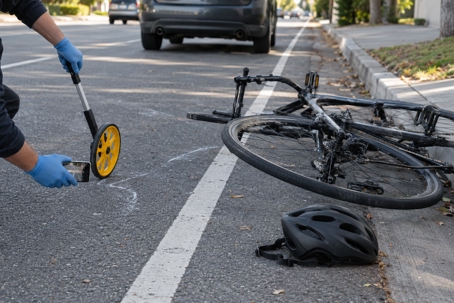
Photographs should capture the entire approach to the collision, not only the damaged bicycle. Useful details include lane width, bike-lane markings, signs, signals, driveway entrances, vegetation, parked vehicles, lighting, shadows, debris, skid or scrape marks, and the final resting positions of the bicycle and vehicle. Measurements and a scene inspection may help explain what each road user could see and how much time was available to react.
Independent witnesses and video
Witnesses may remember the traffic signal, a turn, a horn, braking, or the position of the cyclist before impact. Nearby businesses, residences, buses, traffic systems, and vehicles may have cameras. Footage is often overwritten within days or weeks, so locating and requesting it quickly can make the difference between objective evidence and competing memories.
Vehicle, bicycle, and electronic data
Damage patterns can help identify angle and point of impact. Vehicle event data, infotainment activity, phone records obtained through proper legal process, dash cameras, fitness devices, GPS applications, or an e-bike controller may provide timing or movement information. The bicycle, helmet, clothing, lights, reflectors, and damaged components should be preserved rather than repaired or discarded.
Medical and forensic evidence
Injury location, emergency records, imaging, and treating-provider observations may help connect the mechanics of the impact to the harm. In a fatal collision, the coroner's findings and a qualified reconstruction analysis may be important. Medical evidence should be interpreted by appropriate professionals, not reverse-engineered to support a predetermined story.
Scene measurements, damage patterns, video, and roadway evidence can test early assumptions about fault.
What rules apply to drivers and bicyclists?
California's DMV bicycle and pedestrian guide explains that bicyclists generally have the same rights and responsibilities as motorists. Riders must obey traffic controls and use lights and reflectors when required. Drivers must watch for bicyclists at intersections, when turning, when opening doors, and when entering or leaving driveways.
Passing is another critical issue. California Vehicle Code section 21760 generally requires a driver to move into an available adjacent lane when passing a bicycle if the movement is safe. When that cannot be done, the driver must slow to a reasonable and prudent speed and pass with at least three feet of clearance. The exact roadway configuration and traffic conditions matter.
A rule violation can be important evidence, but it does not replace causation. Investigators must still determine whether the violation contributed to the collision and injury. Likewise, compliance with one rule does not automatically establish that every aspect of a road user's conduct was reasonable.
Can roadway design or maintenance be part of the case?
Sometimes. A missing sign, obscured sight line, broken pavement, unsafe transition, confusing lane configuration, or malfunctioning signal may deserve investigation. The City of Chico maintains a Local Road Safety Plan for evaluating and prioritizing transportation safety improvements. A plan or later improvement does not prove that an earlier road condition was legally dangerous, but official records can help explain the history and control of a location.
Claims involving a city, county, or state agency have special legal elements and defenses. They may also require an administrative claim within a much shorter period than an ordinary lawsuit. An attorney should evaluate the correct public entity and deadline as soon as a roadway condition becomes a serious possibility.
What if the insurance company says the cyclist was partly responsible?
California uses comparative fault. In practical terms, a fact finder may assign percentages of responsibility among people whose conduct contributed to the harm. An injured cyclist is not automatically barred merely because evidence supports some share of responsibility, but any recovery may be reduced. In a wrongful-death case, the same factual disputes can affect the family's claim.
That is why early labels such as “the cyclist came out of nowhere” should be tested against visibility, speed for conditions, attention, road position, timing, and physical evidence. The same scrutiny applies to a cyclist's actions. A credible case is built by confronting inconvenient facts, not hiding them.
What should an injured cyclist or family do next?
Prioritize medical care
Call 911 for urgent injuries and follow recommended care. Head, spine, internal, and orthopedic injuries may not be fully understood at the scene. Keep a record of symptoms, appointments, medications, work restrictions, and out-of-pocket expenses.
Preserve evidence before repairs or disposal
Store the bicycle, helmet, clothing, lights, and electronics in their post-collision condition. Photograph each item. Obtain advice before authorizing destructive testing, repair, or disposal.
Report the collision and locate coverage
Obtain the report number and exchange information when possible. Relevant coverage may include the driver's liability policy, the cyclist's household auto coverage, uninsured or underinsured motorist coverage, medical-payments benefits, or commercial coverage. Policy review is fact-specific.
Avoid public speculation
Social posts made while facts are incomplete can be misunderstood or taken out of context. Families can share necessary safety information while preserving the detailed factual account for investigators, medical providers, and counsel.
How the Law Offices of Larry S. Buckley can help
The Law Offices of Larry S. Buckley represents people in Chico bicycle-accident cases and can coordinate scene investigation, evidence preservation, insurance review, medical documentation, and expert analysis when the facts justify it. For severe head injuries, the firm's brain-injury practice can help connect the legal work with the long-term medical and functional questions that affect a claim.
When a collision is fatal, the firm's wrongful-death attorneys can explain who may bring a claim and what evidence must be preserved. A consultation should clarify options and deadlines; it should not pressure a grieving family to make an immediate litigation decision.
Frequently asked questions
Does a bicyclist always have to stay inside a bike lane?
California law contains circumstances in which a bicyclist may leave a bike lane, including avoiding hazards, passing, preparing for a turn, or approaching a place where a right turn is authorized. The exact facts and current statute should be reviewed.
Does not wearing a helmet eliminate a claim?
No automatic answer applies. Helmet requirements depend on age and vehicle type, and helmet use may be argued in relation to certain injuries. It does not decide who caused the collision. Medical and legal analysis is case-specific.
Can my auto insurance help if I was riding a bicycle?
Possibly. Household uninsured or underinsured motorist and medical-payments coverage may be relevant, depending on policy terms and the collision. Do not assume coverage is unavailable merely because the injured person was not inside a car.
How quickly should video be requested?
Immediately. Many systems overwrite footage on short cycles. Identify nearby cameras and send appropriate preservation requests as soon as possible.
A focused next step
If you or a family member was seriously injured while bicycling in Chico or elsewhere in Northern California, ask for a free consultation focused on the evidence. Bring the report number, photographs, bicycle and helmet information, witness contacts, and any insurer correspondence. The first objective is to understand what can still be preserved and what the facts support.
This article is for general information only. It is not legal advice, does not create an attorney-client relationship, and may not reflect every exception or later change in the law. The facts, deadlines, insurance coverage, and responsible parties in any injury matter must be evaluated individually.