
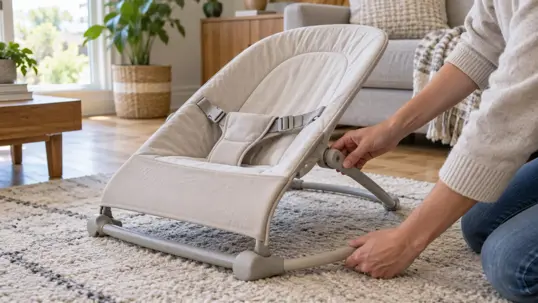
Parents and caregivers should stop using Flyboss 3-in-1 Portable Baby Bouncer and Rocker Chairs immediately. In a September 10, 2026 safety warning, the U.S. Consumer Product Safety Commission said the bouncers can collapse while occupied, creating an impact hazard. CPSC urges consumers to dispose of the products and not sell or give them away.
This is a federal stop-use warning, not a conventional cooperative recall. CPSC reports that the importer, Dougllass LLC, has not responded to requests for a recall or product information. That difference may affect whether consumers receive a repair, replacement, or refund, but it does not change the immediate safety direction: keep children out of the bouncer.
How can parents identify the affected bouncer?
The official CPSC warning identifies Flyboss 3-in-1 Portable Baby Bouncer and Rocker Chairs with three height settings. The products were sold in neutral colors including off-white, gray, and beige, and included an accessory bar with hanging items such as a moon, star, or animal.
Approximately 14,200 units were sold on Amazon from September 2024 through August 2026 for about $40 to $110. CPSC also found the bouncers listed on eBay. Consumers should compare the product and original listing to the photographs and description in the federal warning instead of relying on color alone.
What incidents has CPSC reported?
CPSC says it is aware of 191 reports of the bouncer collapsing during use. In 115 incidents, an infant's head reportedly struck the surface beneath the bouncer, and at least 20 consumers sought medical attention for their infant.
Those figures describe reports known to CPSC as of September 10. They do not establish the medical outcome of each event or the legal responsibility for any particular injury. The number of reports and the agency's instructions can change, so the warning should be rechecked before publication or action.
What should a parent do with the product?
- Remove the child and stop using the bouncer immediately.
- Do not test the frame by placing a child in it.
- Do not sell, donate, or give the bouncer to another family.
- Follow the current disposal direction in the CPSC warning.
- Save the order history, product listing, seller name, photographs, and communications.
If no incident occurred, the safety priority is disposal as CPSC directs. Before discarding it, a consumer may photograph the entire product, frame joints, labels, packaging, and online order record so the model and transaction are documented.
Photographs and online purchase records can help identify the exact product and seller.
What if a child was in the bouncer when it collapsed?
Obtain appropriate medical advice, particularly if the child's head struck a surface or the child developed symptoms. Emergency services should be used when the child appears seriously injured or a caregiver believes an emergency exists. A lawyer cannot diagnose a head injury, and the absence of an obvious mark does not replace a medical assessment.
When immediate needs have been addressed, write down what happened while the sequence is fresh. Note the bouncer's position and height setting, the surface beneath it, whether the restraint was in use, what the caregiver observed, and what the child did afterward. Preserve photographs and unedited video, medical discharge instructions, bills, and follow-up recommendations.
Report the incident through SaferProducts.gov. The report can help CPSC identify patterns, but it is separate from contacting a seller, insurer, or attorney.
Should an injured family keep or dispose of the bouncer?
This question requires both safety and evidence considerations. CPSC directs consumers to dispose of the product. A family should never continue using it or leave it where another child can access it. At the same time, the product's condition can matter if a serious injury occurred.
Before disposal, photograph every side, joint, fastener, restraint, label, accessory, and damaged area. Retain packaging, instructions, receipts, order history, seller communications, and any video of the event. If the product can be secured without exposing a child or adult to danger, obtain prompt case-specific advice about inspection and preservation. If safe retention is not possible, follow CPSC's direction and document the disposal.
Does a federal warning prove a product-liability case?
No. The warning is significant evidence of a reported safety problem, but an individual claim still depends on identifying the product and seller, establishing what failed, connecting that failure to the injury, and documenting the resulting harm. The manufacturer or seller may raise issues involving product identification, assembly, alterations, instructions, other causes, and the nature of the injury.
Online marketplace purchases can add questions about the importer, storefront, fulfillment records, payment information, and which business placed the product into commerce. Saving screenshots and order details promptly can help identify parties that may otherwise be difficult to trace after a listing disappears.
How can the Law Offices of Larry S. Buckley help?
The Northern California product-liability attorneys at the Law Offices of Larry S. Buckley can evaluate the product, transaction history, failure evidence, medical records, and potential responsible parties. Depending on the issues, a case may require engineers, product-safety professionals, medical experts, or other qualified specialists.
When a collapse involves a possible head impact, the firm can also evaluate the legal and insurance issues associated with a documented brain injury. Any investigation should follow the medical evidence rather than assume that every impact caused a lasting condition.
Frequently asked questions
Is this an official recall?
CPSC issued a stop-use safety warning. The agency says the importer has not responded to its request for a recall or product information.
Can I donate the bouncer if it never collapsed?
No. CPSC specifically says not to sell or give away the hazardous product.
Where were the bouncers sold?
CPSC reports sales through Amazon from September 2024 through August 2026 and says the product has also been found on eBay.
Should I report an incident even if the child seems fine?
A product incident may be reported to CPSC regardless of whether a lasting injury is apparent. Medical questions should be directed to a qualified health professional.
What records should I save from an online purchase?
Save the order page, confirmation email, invoice, seller name, payment record, product description, photographs, and all communications about a return, refund, or complaint.
Talk with a Northern California product-injury attorney
If an infant was injured when a bouncer collapsed, call the Law Offices of Larry S. Buckley at 530-413-0245 or request a free case evaluation. Stop using the product immediately and place medical and child-safety needs ahead of evidence collection.