
The most vulnerable crash evidence should be identified and preserved as soon as safety and medical needs allow. Doorbell and business-surveillance systems may overwrite recordings. Vehicles may be repaired or sold. Roadway marks fade, construction changes the scene, and witnesses forget precise details. Preserving evidence does not mean deciding fault in advance; it means protecting the information needed to evaluate competing accounts fairly.
A recent Butte County prosecution illustrates the range of evidence that can exist outside the vehicles themselves. In reporting on a Highway 99-area collision, KRCR stated that prosecutors described eyewitness accounts, footage from a nearby residence, and blood-test evidence. Those are prosecution allegations in a pending criminal matter, not civil findings. They nevertheless show why a prompt, lawful investigation can matter after any serious intersection collision.
Why can video disappear so quickly?
Many home, retail, apartment, warehouse, and traffic-camera systems operate on a loop. New footage replaces older footage after a set period or when storage fills. The owner may have no reason to save a recording unless someone identifies the correct camera, time window, and direction of travel.
A useful preservation request should be specific enough to locate the material. It may identify the date, approximate time, intersection, camera position, and the minutes before and after the collision. A broad demand for every recording on a system can create unnecessary privacy objections and delay.
People should not trespass, impersonate law enforcement, or attempt to access another person's account. An attorney or investigator can contact potential custodians, request voluntary preservation, and use formal legal process when appropriate.
What information may be stored in the vehicles?
Some vehicles contain event-data recorders that may capture a short window of information associated with a qualifying event. Depending on the vehicle, available fields can include speed, throttle position, braking, seat-belt status, steering input, or airbag deployment. The recorder does not answer every question, and data availability varies by model and event.
Modern vehicles may also store information in infotainment systems, driver-assistance modules, telematics services, or connected applications. Access can require owner permission, appropriate equipment, or a court-authorized process. A technically qualified examiner should collect electronic data in a way that preserves its integrity and documents how it was obtained.
If a vehicle may contain important evidence, extensive repairs, destruction, salvage transfer, or software changes should not occur before preservation questions are addressed. The owner still must comply with lawful storage, insurance, and safety requirements.
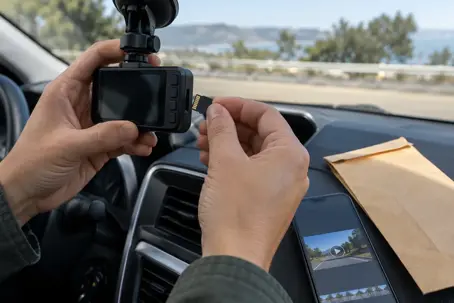
Dash-camera files should be copied promptly while preserving the original card and file information.
What scene evidence should be documented?
Scene photographs are most useful when they provide context, not merely close-ups of damage. Useful subjects may include:
- Approach lanes, sight lines, stop bars, signals, signs, and pavement markings.
- Vehicle-rest positions, debris, fluid, gouges, tire marks, and damaged barriers.
- Lighting, weather, vegetation, parked vehicles, construction, and visual obstructions.
- Nearby cameras on homes, businesses, buses, parking areas, and traffic equipment.
- Damage to each side of every involved vehicle before repairs begin.
Measurements, drone imagery, and three-dimensional scanning can be valuable in major cases, but they should be performed lawfully and safely. A person should never stand in active traffic or interfere with emergency responders to take photographs.
Why are witnesses and dispatch records important?
A neutral witness may have observed a traffic signal, speed, lane position, lighting, or conduct before impact. Names, phone numbers, vehicle descriptions, and the witness's viewing location can be more valuable than a hurried summary at the scene.
911 calls, dispatch recordings, computer-aided dispatch logs, body-camera recordings, and first-responder observations can help establish timing and document conditions. Retention policies and access rules vary, especially for law-enforcement and public-agency records. Requests may need to be made before routine deletion and may be delayed or restricted during an active investigation.
How do medical records become part of the evidence?
Medical records document symptoms, examinations, diagnoses, treatment, restrictions, and progress. They can help connect the collision to the claimed injuries and show how the injuries affected daily activities and work. Treating professionals, not attorneys, determine medical care.
Injured people should describe symptoms accurately, attend medically appropriate follow-up care, and keep bills, mileage, pharmacy records, wage information, and work-status notes. A simple contemporaneous record of daily limitations may be useful, but it should be factual rather than exaggerated.
What can an injured person do during the first few days?
- Obtain appropriate medical attention and follow emergency instructions.
- Save original photographs and videos without editing or adding filters.
- Download and protect dash-camera footage before the device loops over it.
- Write down witness names, camera locations, tow-yard information, and insurer contacts.
- Keep damaged property and safety equipment when it can be stored safely.
- Avoid speculative social-media posts or public accusations about fault.
- Ask counsel about targeted preservation notices when injuries are serious or responsibility is disputed.
How can the Law Offices of Larry S. Buckley help preserve crash evidence?
The Northern California car-accident attorneys at the Law Offices of Larry S. Buckley can identify likely evidence sources, coordinate qualified investigators, request records, and evaluate whether reconstruction or technical examination is justified. The firm's work may involve accident-reconstruction professionals, biomechanical engineers, medical specialists, vocational consultants, and economists depending on the injuries and disputed issues.
The goal is not to collect everything imaginable. It is to preserve the material that can reliably answer how the collision occurred, who may be responsible, whether the impact caused the claimed injuries, and what losses can be supported. For more detail, see the firm's guide to how an attorney can preserve evidence after a suspected distracted-driving crash.
Frequently asked questions
Can I ask a homeowner for doorbell-camera footage?
Yes, you may make a respectful request, but the owner may decline. Do not enter property without permission or attempt to access the system. Counsel can send a focused preservation request and evaluate formal process.
Should I repair my vehicle immediately?
Make it safe and follow insurer and storage requirements, but document all sides before repair. In a serious or disputed case, ask whether an inspection or data download should occur first.
Does a police report conclusively decide fault?
No. It is important evidence, but insurers and courts may examine physical evidence, testimony, video, electronic data, and applicable law independently.
Can deleted video be recovered?
Sometimes, but recovery depends on the device, storage method, overwrite activity, and access. Prompt preservation is more reliable and usually less costly than attempted recovery.
How soon should preservation begin?
As soon as practical after urgent medical and safety needs are addressed. Evidence can disappear long before the legal filing deadline expires.
Protect the evidence before it changes
If a serious Northern California collision left you or a family member injured, call the Law Offices of Larry S. Buckley at 530-413-0245 or request a free case evaluation. The firm can assess which evidence matters and what lawful preservation steps should be taken now.